

By Dr Peter Fowler, PhD (Sport Science). Prices and specifications checked 13 October 2026.
The short answer: there isn't one best compression boot for everyone. The right boot depends on where you'll use it, how much control you want and what you want to spend. Here's how I'd choose in Australia right now:
- Best wireless value: PROAir Wireless ($495, on sale for $420 at the time of writing). Full-leg, no hoses, up to 240 mmHg.
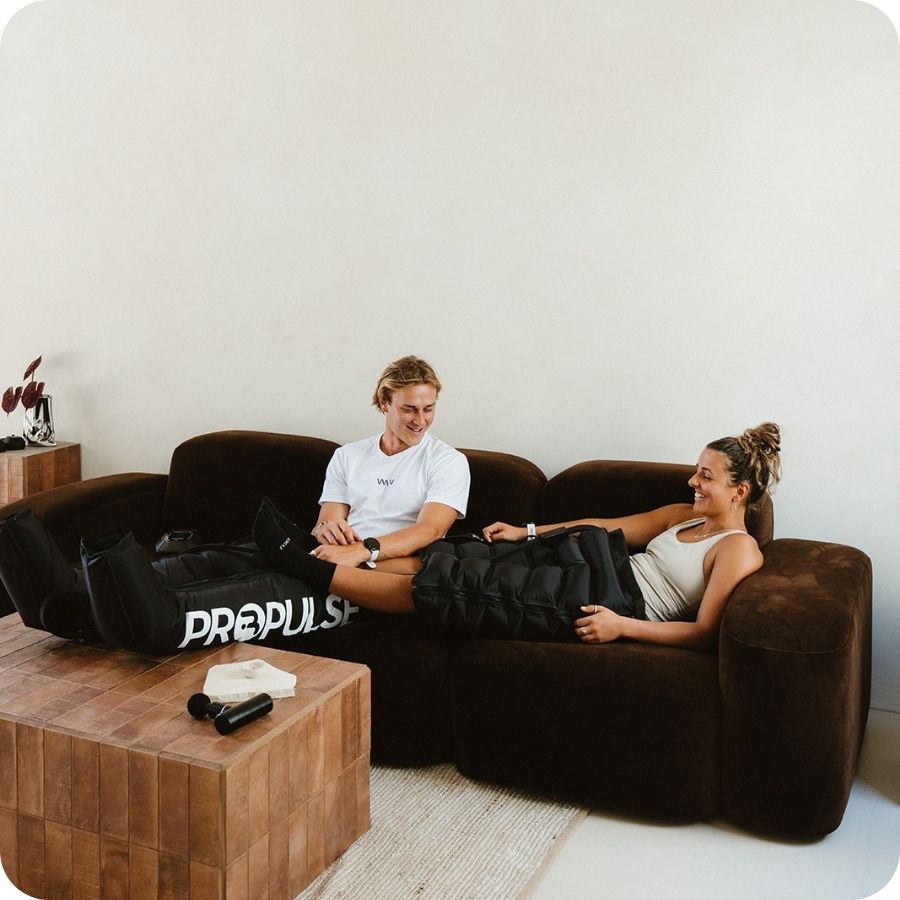
- Best for maximum control: PROPulse ($695, on sale for $645 at the time of writing). Six chambers, 30 to 260 mmHg in 5 mmHg steps, and you can switch individual chambers off.
- Best premium system: Hyperice Normatec Elite ($1,799). Cord-free, three sizes, strong brand support.
- Best for travel: BLACKROLL Compression Boots 2.0 ($889.90). Fully wireless, 3.5 hours of battery, runs off USB-C, four sizes.
- Lowest-priced six-chamber option: NERV Squeeze ($569), if you're happy with one size and can wait on stock.
- Calves only, or a first step: PROLite ($350, on sale for $275 at the time of writing) or Normatec Lower Legs ($599).
Two of those picks are ours, and four aren't. I co-own The Recovery Project, so I've set out exactly how I compared everything further down. Where another brand does something better, I say so.
Compression boots compared: Australian prices and specs
Every figure below comes from the brand's own Australian website (or official Australian store) on 13 October 2026. Where a brand's own pages disagree with each other, I've noted it. Prices move often, especially around sales, so check before you buy.
| Boot | Price (AUD) | Chambers | Pressure (mmHg) | Hoses or wireless | Battery | Sizing | Warranty |
|---|---|---|---|---|---|---|---|
| Recovery Project PROAir | $495 (sale: $420) | 4 | 80 to 240 | Wireless, no hoses | 2+ hrs. Can't run while plugged in | One size, 97 cm long | 1 year |
| Recovery Project PROPulse | $695 (sale: $645) | 6, each can be switched off | 30 to 260, in 5 mmHg steps | Control unit with hoses | 3+ hrs, or run plugged in | One size, 100 cm long. Zip extenders on request | 1 year |
| Hyperice Normatec 3 Legs | $1,439 | 5 zones | 40 to 110 (7 levels) | Control unit with hose | Up to 3 hrs | Short, Standard, Tall | Not stated on product page |
| Hyperice Normatec Elite Legs | $1,799 | 5 zones | 40 to 110 (7 levels) | Wireless, no hoses | Up to 4 hrs | Short, Standard, Tall | Not stated on product page |
| Therabody JetBoots Prime | $799 | 4 | 25 to 100 (4 levels) | Wireless, built-in pump | 180 min | Short, Regular, Long | 1 year limited |
| Therabody JetBoots PRO Plus | $1,499 | 4 | 20 to 100, in 5 mmHg steps | Wireless. Adds LED and vibration | 150 to 240 min | Sized, see brand's chart | 2 years limited in specs (page also shows a 1-year badge) |
| NERV Squeeze | $569 | 6 | 60 to 270 | Control unit | 3 to 4 hrs, or run plugged in | One size, 81 cm leg. Listed for 5'4" to 6'4" | 1 year |
| VERVE Compression Recovery Boots (wired) | $949 | 5, can isolate chambers | 50 to 150 (11 levels) | Control unit with two hoses | Up to 2 hrs | Universal, about 86 cm long | At least 1 year |
| VERVE Wireless | $999 | Not stated | Not stated | Wireless, Bluetooth paired | Up to 2.5 hrs | Not stated | At least 1 year |
| BLACKROLL Compression Boots 2.0 | $889.90 | 5 | 20 to 120 (5 levels) | Wireless, built-in pumps | 3.5 hrs. Can run via USB-C | S, M, L, XL by inside leg | 2 years (consumer) |
| Air Relax AR-2.0 | From $990 | 4 | Up to 200 | Not stated | Not stated | Not stated on home page | 1 year |
| Recovery Project PROLite (calves and arms) | $350 (sale: $275) | 3 | 3 intensity levels (mmHg not listed) | Wireless sleeves | 2 to 3 hrs | 38 cm sleeve | 1 year |
| Hyperice Normatec Lower Legs (calves) | $599 | 3 zones | 40 to 200 (7 levels) | Wireless, Bluetooth | Up to 3 hrs | One size listed | Not stated on product page |
Sources: recoveryproject.com.au, hyperice.com/en-au, therabody.com.au, nervrecovery.com/au, vervefitness.com.au, blackroll.com.au and airrelax.com.au, all checked 13 October 2026. For our own products, the regular price is shown first, with the Black Friday sale price that applied on that date. Product features and prices change, so confirm current details with the manufacturer before you buy.
My picks by category, and who each one suits
Best wireless value: PROAir Wireless
PROAir puts the pump and controls into the boots, so there are no hoses and no separate box. It runs four chambers from 80 to 240 mmHg with five massage modes. At its regular price of $495 it's the lowest-priced full-leg wireless boot in the table above. The current sale price widens the gap.
It suits: people who want to recover on the couch, at the gym or in a hotel room without setting anything up.
Limitations: the battery gives 2+ hours per charge and you can't run it while it's plugged in, so charge it after use. It comes in one length (97 cm). It has four chambers, not six. If you want chamber-by-chamber control, PROPulse is the better fit. I compare it head to head in PROAir vs Normatec.
Best for maximum control: PROPulse
PROPulse has six overlapping chambers, a 30 to 260 mmHg range adjustable in 5 mmHg steps, and six modes. You can switch individual chambers off. That's useful if one area is tender, or if you're shorter and want the top chamber off. It runs on a rechargeable battery (3+ hours) or plugged in.
It suits: people who want to fine-tune pressure and coverage, and anyone who'll mostly use boots at home.
Limitations: it uses a separate control unit with hoses, so it's a little more to pack than a wireless boot. It's one length (100 cm), with zip extenders available on request for larger legs. See PROPulse vs Normatec for the detail.
Best premium system: Hyperice Normatec Elite
Normatec is the brand most people know, and the Elite is its cord-free leg system. It comes in three sizes, which matters if you're very short or very tall. If budget isn't the deciding factor and you want the most established name, it's a strong choice.
Limitations: it's the most expensive leg system in the table at $1,799. Its pressure range tops out at 110 mmHg. As I explain below, that's not the drawback it's sometimes made out to be.
Best for travel: BLACKROLL Compression Boots 2.0
For a frequent traveller, this is the one I'd point to. It's fully wireless, it lists 3.5 hours of battery and it can run off USB-C. It also comes in four sizes measured by inside leg. Its pressure range (20 to 120 mmHg) is lower than ours, but it sits right in the range most research has used.
Lowest-priced six-chamber option: NERV Squeeze
At $569, NERV Squeeze is the cheapest six-chamber leg boot I could verify on an official Australian-facing site. It lists 60 to 270 mmHg and can run on battery or plugged in.
Limitations: it's one size with an 81 cm leg length. On the day I checked, the page showed it as backordered and sold out. Its delivery information was also inconsistent (2 to 5 days in one place, 5 to 15 business days in the FAQ). Confirm stock and delivery before you order.
Calves only, or a first step: PROLite or Normatec Lower Legs
If your problem is mostly tight calves, or you want something small for travel or a younger athlete, calf sleeves make sense. PROLite is the budget option at $350 ($275 on sale at the time of writing). Normatec Lower Legs costs $599 and adds app control and a published 40 to 200 mmHg range.
What actually matters when you compare compression boots?
When I assess a boot, I start with the research, not the spec sheet. Here's what the evidence and the physiology say matters, roughly in order.
1. Fit and coverage
A boot only works where it squeezes. If it stops short of your upper thigh, you lose coverage. If it's too long, the top chamber sits in your hip crease. Check the boot length against your inside leg. One-size boots (including ours) suit most adults. People at either end of the height range are better served by a brand with multiple sizes, or by a boot that lets you switch the top chamber off.
2. Comfortable, adjustable pressure
A 2024 systematic review and meta-analysis pooled 17 studies with 319 participants. It found the most common protocols ran about 20 to 30 minutes at about 80 mmHg (Maia et al., 2024). Higher pressure does increase blood flow velocity during the session. One study compared 80 and 200 mmHg and found the bigger increase at 200, but blood flow returned close to baseline within two minutes of stopping (Maia et al., 2024, IJSPP). Another study found 135 mmHg gave no extra range-of-motion benefit over 80 mmHg (Yanaoka et al., 2022). So what you want is a range that reaches a comfortable working pressure for you, with fine enough steps to find it.
3. Sequential, overlapping chambers
Good boots inflate from the foot upward in a wave, and overlapping chambers avoid gaps. Four, five or six chambers can all do this well. More chambers give finer control over where pressure lands. I haven't found evidence that six chambers produce better recovery outcomes than four or five, so treat chamber count as a comfort and control feature.
4. How you'll actually use them
Wireless boots win for convenience and travel. A control unit with hoses usually gives more adjustment. Be honest about where you'll use them. A boot you can set up in ten seconds gets used more often.
5. Warranty, returns and local support
These are pneumatic devices with pumps, valves and zips. Know who handles a fault, and where. In the table, published warranties range from 1 year to 2 years, and some brands don't state one on the product page. Return windows vary too: 14 days at VERVE, 30 days at NERV, Air Relax and us.
Which specs are mostly marketing?
- Maximum pressure. This includes our own 240 and 260 mmHg ceilings. A high ceiling gives you headroom if you like firm pressure. It isn't proof of better recovery. Most of the research sits around 70 to 80 mmHg.
- Mode counts. A long list of modes sounds impressive. In practice most people settle on one or two. One competitor's page claims 12 modes and lists three.
- "Flushes lactate and toxins." One study found lower blood lactate after boots, but no difference in repeat performance (Martin et al., 2015). Another found higher lactate in the next ride (Marcello et al., 2019). Lactate clearance isn't a good reason to buy boots.
- "Clinically proven recovery." The evidence for boots is modest and mixed. More on that below.
How much do compression boots cost in Australia?
Based on the official prices above (13 October 2026):
- Under $700: PROLite ($350, calves), PROAir ($495), NERV Squeeze ($569), Normatec Lower Legs ($599, calves) and PROPulse ($695). Sale prices were lower again on the day I checked. Endurance (recoveryboots.com.au) also had boots listed at 50% off, from $474.50.
- $700 to $1,000: Therabody JetBoots Prime ($799), BLACKROLL ($889.90), VERVE ($949 and $999), Air Relax AR-2.0 (from $990).
- Over $1,000: Normatec 3 Legs ($1,439), JetBoots PRO Plus ($1,499), Normatec Elite ($1,799).
I compare the cheaper options in detail in Best Compression Boots Under $700 in Australia.
Spending more mostly buys brand, sizing options, app features and extras like LED or vibration. It doesn't buy a different kind of compression. Every boot here works on the same principle.
Do compression boots actually work?
Yes, but modestly, and mostly in how your legs feel. The best summary is the 2024 meta-analysis: a trivial to small benefit for muscle function, a trivial to moderate benefit for pain and soreness, and inconsistent effects on muscle damage markers (Maia et al., 2024). Studies that measured next-day performance mostly found no difference. A 2025 meta-analysis found moderate-certainty evidence of no reduction in soreness at 24 hours (Canez et al., 2025). A 2023 review placed recovery boots below foam rolling, compression garments, cryotherapy and active recovery on strength of evidence (Driller & Leabeater, 2023).
That's why I treat boots as a good addition to sleep, nutrition and sensible training load, never a replacement. I go through every study in Do Compression Boots Actually Work? What the Research Says.
Who should check with a doctor first?
Pneumatic compression is a medical technology as well as a recovery tool. Clinical guidelines note that some conditions rule it out or need care (Schwahn-Schreiber et al., 2018). Speak to your doctor before using compression boots if you have a known or suspected blood clot, a circulation, heart or kidney condition, an acute injury, open wounds or skin problems on your legs, or if you're pregnant.
Why trust this guide?
I hold a PhD in sport science, researching sleep and recovery in athletes, and an MSc in exercise physiology. I'm an ESSA Accredited Sports Scientist (Level 2). I've worked in high-performance sport for more than 15 years. That includes the Australian Institute of Sport, where I delivered and supervised athlete recovery sessions in the AIS Recovery Centre, and Aspetar in Qatar, where I set up and directed a performance recovery research program. More on my background here.
How I compared: specs and prices come only from each brand's official Australian website or store, checked on 13 October 2026. I didn't use other brands' comparison articles as a source for anyone's specs. I haven't run independent lab tests on these boots, and this guide doesn't claim I have.
Disclosure: I co-own The Recovery Project, which sells PROAir, PROPulse and PROLite. Many "best compression boots" lists earn a commission from the brands they rank. It's worth checking the disclosure on any list you read, including this one.
Frequently asked questions
What are the best compression boots in Australia?
It depends on your priorities. For wireless value I'd choose PROAir. For control, PROPulse. For a premium name with multiple sizes, Normatec Elite. For travel, BLACKROLL. For the lowest-priced six-chamber boot, NERV Squeeze, subject to stock.
How much should I spend on compression boots?
Full-leg boots from official Australian sites ranged from $495 to $1,799 at regular prices on 13 October 2026, with sale prices lower. You don't need to spend over $1,000 to get effective sequential compression.
Is Normatec worth the extra money?
Normatec is well made and comes in three sizes, which helps very short or tall users. If those features matter to you, it can be worth it. If they don't, you're mostly paying for the brand. I break this down in Normatec Alternatives in Australia.
Should I buy wireless or wired compression boots?
Wireless if convenience and travel matter most. A control unit with hoses if you want more adjustment and will mostly use them at home. See Best Wireless Compression Boots Australia.
What pressure should I use?
Start low and build to a firm but comfortable squeeze. Most research has used around 70 to 80 mmHg. Higher isn't proven to be better.
How long and how often should I use them?
Most studies used 20 to 30 minute sessions (Maia et al., 2024). See How Often Should You Use Compression Boots? for a practical routine.
Are compression boots safe?
A German clinical guideline on pneumatic compression describes adverse events as extremely rare when it's used correctly (Schwahn-Schreiber et al., 2018). Check with your doctor first if you have any of the conditions listed above.
New to boots altogether? Start with Compression Boots: The Complete Australian Guide. If you run, see Compression Boots for Runners.
References
- Maia F, Nakamura FY, Sarmento H, Marcelino R, Ribeiro J. Effects of lower-limb intermittent pneumatic compression on sports recovery: a systematic review and meta-analysis. Biol Sport. 2024;41:263-275. doi:10.5114/biolsport.2024.133665
- Maia F, Machado MVB, Silva G, Nakamura FY, Ribeiro J. Hemodynamic effects of intermittent pneumatic compression on athletes: a double-blinded randomized crossover study. Int J Sports Physiol Perform. 2024;19:932-938. doi:10.1123/ijspp.2024-0017
- Yanaoka T, Numata U, Nagano K, Kurosaka S, Kawashima H. Effects of different intermittent pneumatic compression stimuli on ankle dorsiflexion range of motion. Front Physiol. 2022;13:1054806. doi:10.3389/fphys.2022.1054806
- Canez MS, da Silva LI, Ferreira GD, de Araújo FX, Luza LP. Effects of photobiomodulation, intermittent pneumatic compression and neuromuscular electrical stimulation on muscle recovery: systematic review with meta-analysis. J Bodyw Mov Ther. 2025;44:570-584. doi:10.1016/j.jbmt.2025.06.021
- Driller M, Leabeater A. Fundamentals or icing on top of the cake? A narrative review of recovery strategies and devices for athletes. Sports (Basel). 2023;11:213. doi:10.3390/sports11110213
- Martin JS, Friedenreich ZD, Borges AR, Roberts MD. Acute effects of peristaltic pneumatic compression on repeated anaerobic exercise performance and blood lactate clearance. J Strength Cond Res. 2015;29:2900-2906. doi:10.1519/JSC.0000000000000928
- Marcello RT, Fortini L, Greer BK. Intermittent pneumatic compression boot use elevates blood lactate during subsequent exercise. Int J Exerc Sci. 2019;12:385-392. PubMed 30899344
- Schwahn-Schreiber C, Breu FX, Rabe E, et al. S1 guideline on intermittent pneumatic compression (IPC). Hautarzt. 2018;69:662-673. doi:10.1007/s00105-018-4219-1
Last updated 13 October 2026. Prices and specifications checked 13 October 2026. Product features can change, so confirm current information with the manufacturer before purchase.
About the author. Dr Peter Fowler holds a PhD in sport science (Charles Sturt University), where he researched sleep and recovery in athletes, and an MSc in exercise physiology (Loughborough University). He is an ESSA Accredited Sports Scientist (Level 2). He has spent more than 15 years in high-performance sport and athlete recovery, including roles at the Australian Institute of Sport, Tottenham Hotspur and Aspetar in Qatar. He co-owns The Recovery Project. Read Dr Fowler's full background.


Leave a comment
All comments are moderated before being published.
This site is protected by hCaptcha and the hCaptcha Privacy Policy and Terms of Service apply.